


Committed UA financing now exceeds early-stage equity in mobile games and consumer apps
US-based AI English-learning ppa Buddy.ai has secured a $15m user acquisition (UA) facility from New York-based Braavo Capital. The company draws the money as it buys users and repays each advance from the revenue those users generate, without giving up equity. Braavo says it has committed over $60m to facilities like this one in 2026.
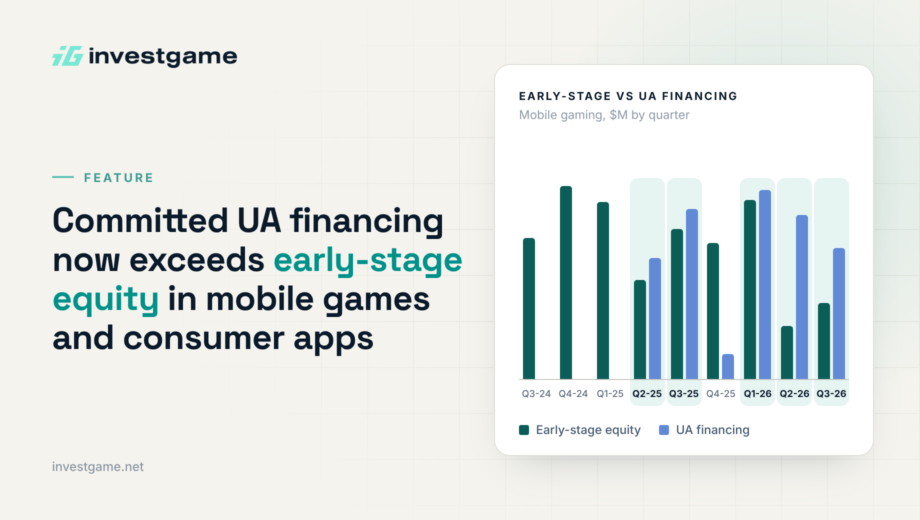
Cohort financing has existed for years and has grown fast: since 2025, committed UA facilities for mobile games have become one of the dominant financing alternatives for mobile studios. In the first three quarters of 2026, they totaled $398m against $254m of early-stage rounds, so UA facilities made up 61% of the combined $652m. Studios that once sold equity to pay for installs can now fund them from the revenue of the users they acquire, and keep their equity for product and hiring.
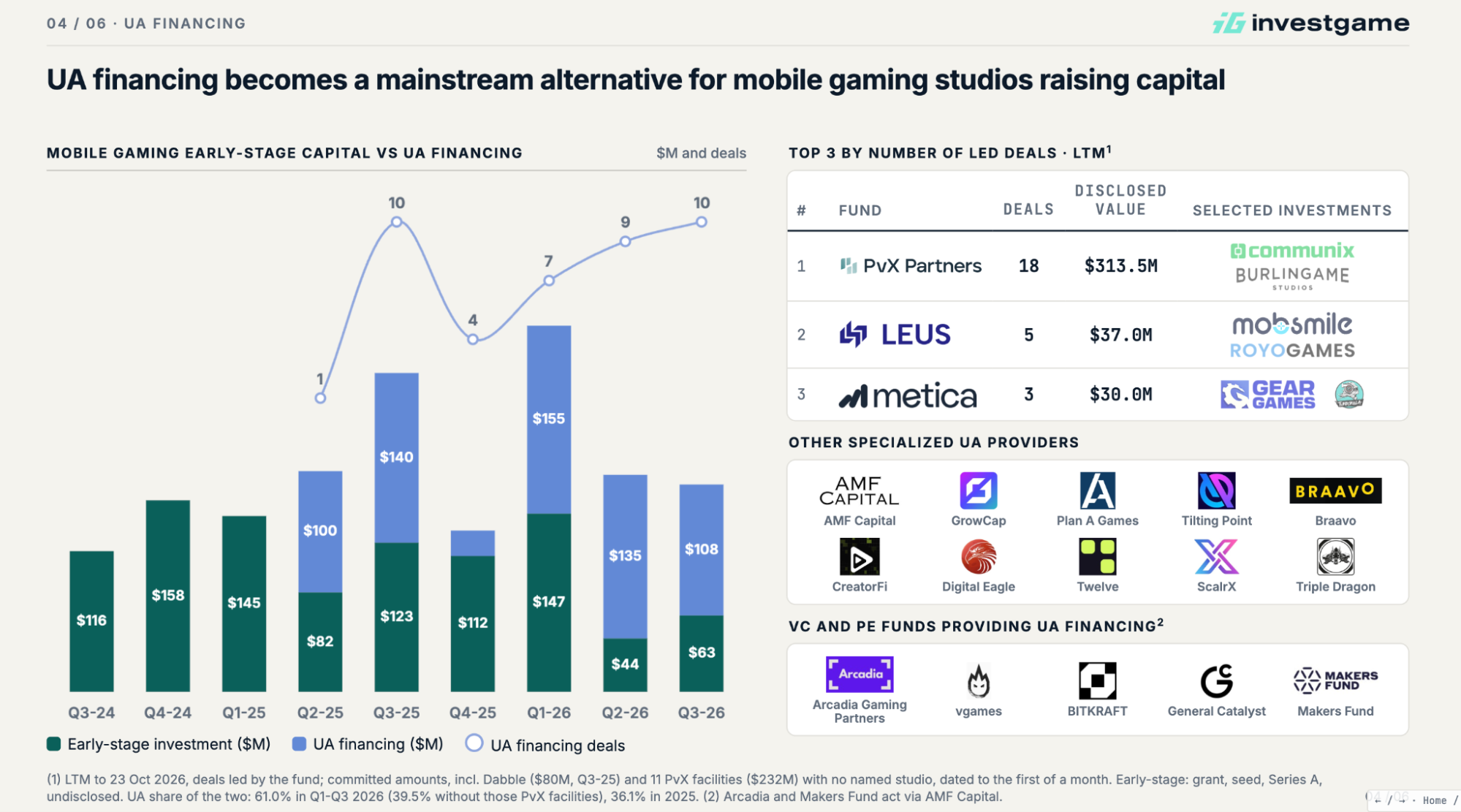
Terms differ by provider. PvX Partners is repaid through a share of the revenue of the cohorts it funds, up to a return cap agreed in advance, while Plan A Games charges a fixed interest rate on the capital the studio draws, plus a success fee if the game reaches a revenue target set at the start.
General Catalyst has the largest balance sheet behind the model. Its Customer Value Fund provides the balance sheet for PvX, the most active provider, and General Catalyst also invests in it. Through the same fund, General Catalyst financed SuperPlay’s UA without taking equity, and SuperPlay CEO Gilad Almog called the product “almost like a secret weapon”. In 2024, Playtika (NASDAQ: PLTK) agreed to acquire the Israel-based studio for $700m upfront plus up to $1.25B in earn-outs. Today, General Catalyst deploys mostly through partners: PvX announced more than $250m of committed facilities for 20 mobile game and consumer app companies in Dec’25, rising to over $750m by Apr’26, while Israel-based vgames had deployed over $350m into UA and marketing financing by Dec’25 and targets a further $500m over the following 12 months.
Capital is also changing beyond mobile. A wave of new funds now backs game ideas: Griffin Gaming Partners launched a $100m fund in May’26 that pays for indie games in exchange for a share of each game’s revenue; Denmu, led by Ryan You and Michael Fan, has secured most of the commitments for a $50m fund that finances specific games rather than studios, mixing project financing with equity, with typical checks of $1–5m; and Simon Zhu launched GreaterThan Group, a holding company in which studio leads hold equity in both their studio and the parent, with $40m raised and around $60m of further commitments.
Money once used to fund installs through an equity round now comes from lenders, and in 2026 it already accounts for most of the total.




