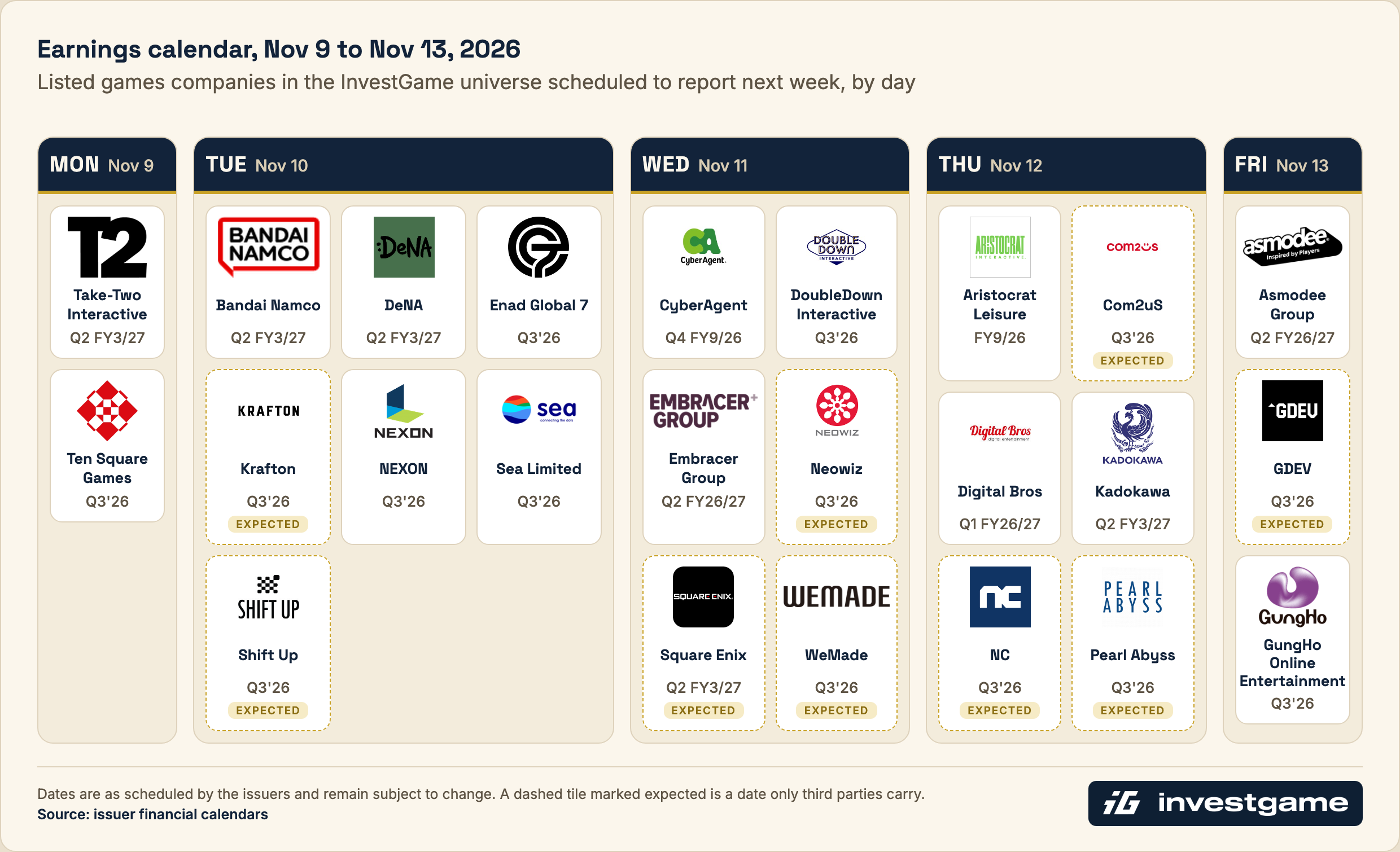
Weekly News Digest #45


Micro-drama app EloElo raises $80m from Hornbill Capital and NBCUniversal
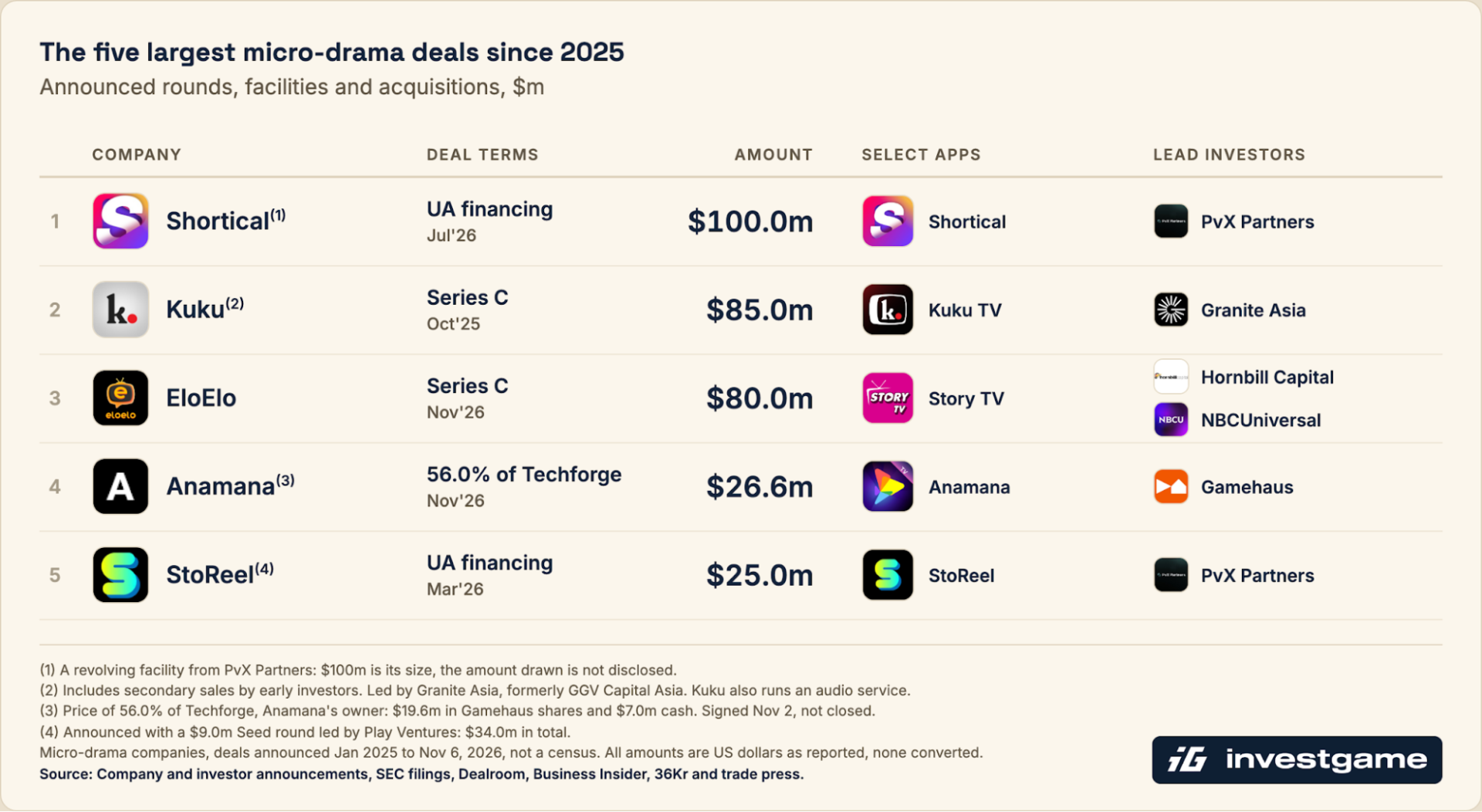
India-based AI-native media and entertainment company EloElo Group has raised $80m in a Series C led by Hornbill Capital and NBCUniversal, announced on Nov 4. That brings its total funding to $130m. MIT Investment Management Company joined, along with existing investors Play Ventures, Kalaari Capital, WaterBridge Ventures and Griffin Gaming Partners. The round values EloElo at ~$500m, according to sources cited by PTI. Its lead product, the micro-drama app Story TV, carries more than 5,000 dramas in six languages, and EloElo says its apps reach over 40 million monthly users. The funds will support original local-language titles, the launch of its micro-dramas outside India, including the US, and its Dolphin AI production suite. Founder and CEO Saurabh Pandey told The Economic Times that NBCUniversal will provide strategic input on content and international expansion.
Micro-drama apps are growing fast. Omdia expects global micro-drama revenue of $14.0B in 2026, up 27% from $11.0B in 2025. StoReel’s co-CEO Angela Yu says AI tools make episodes faster and cheaper to produce.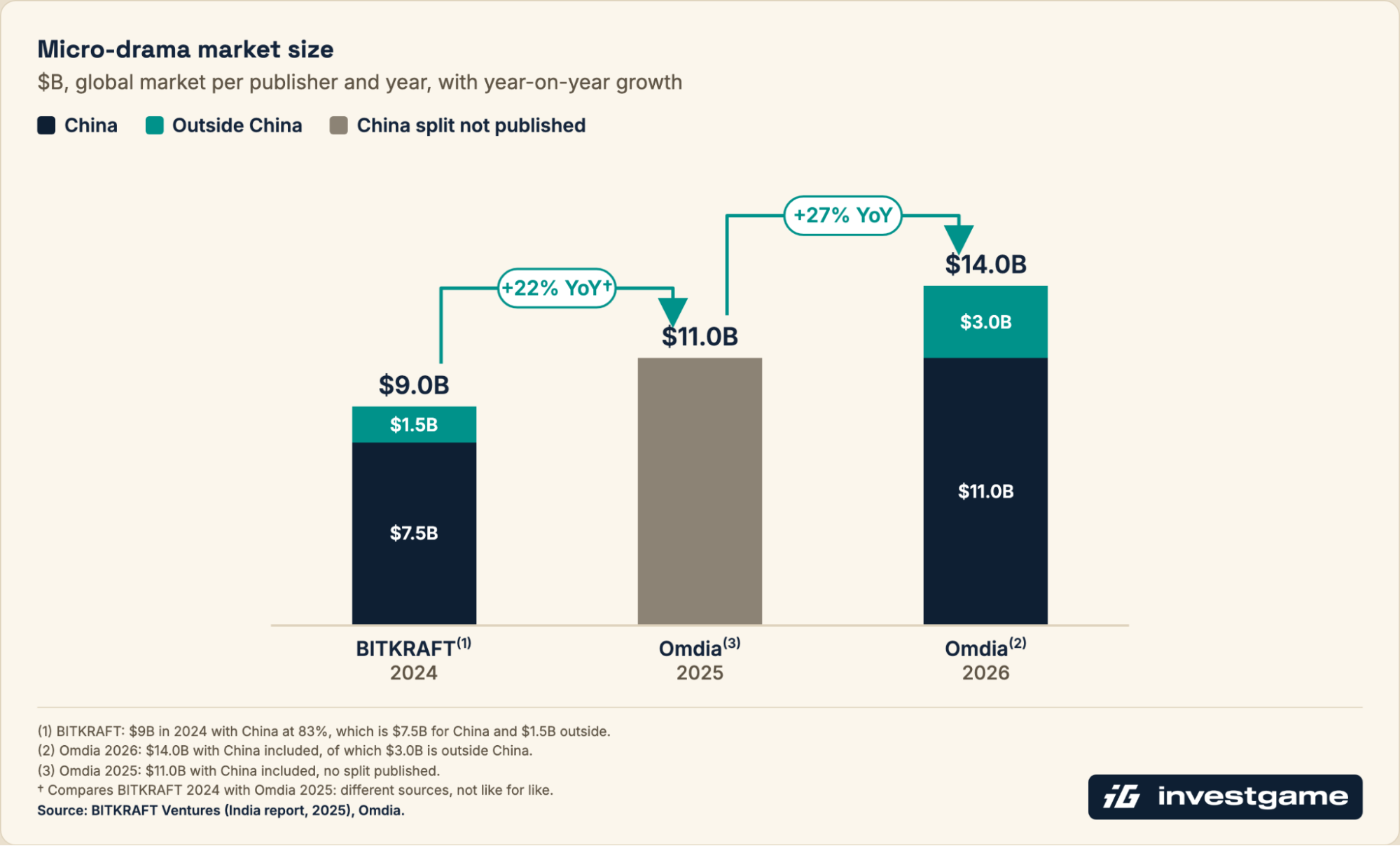
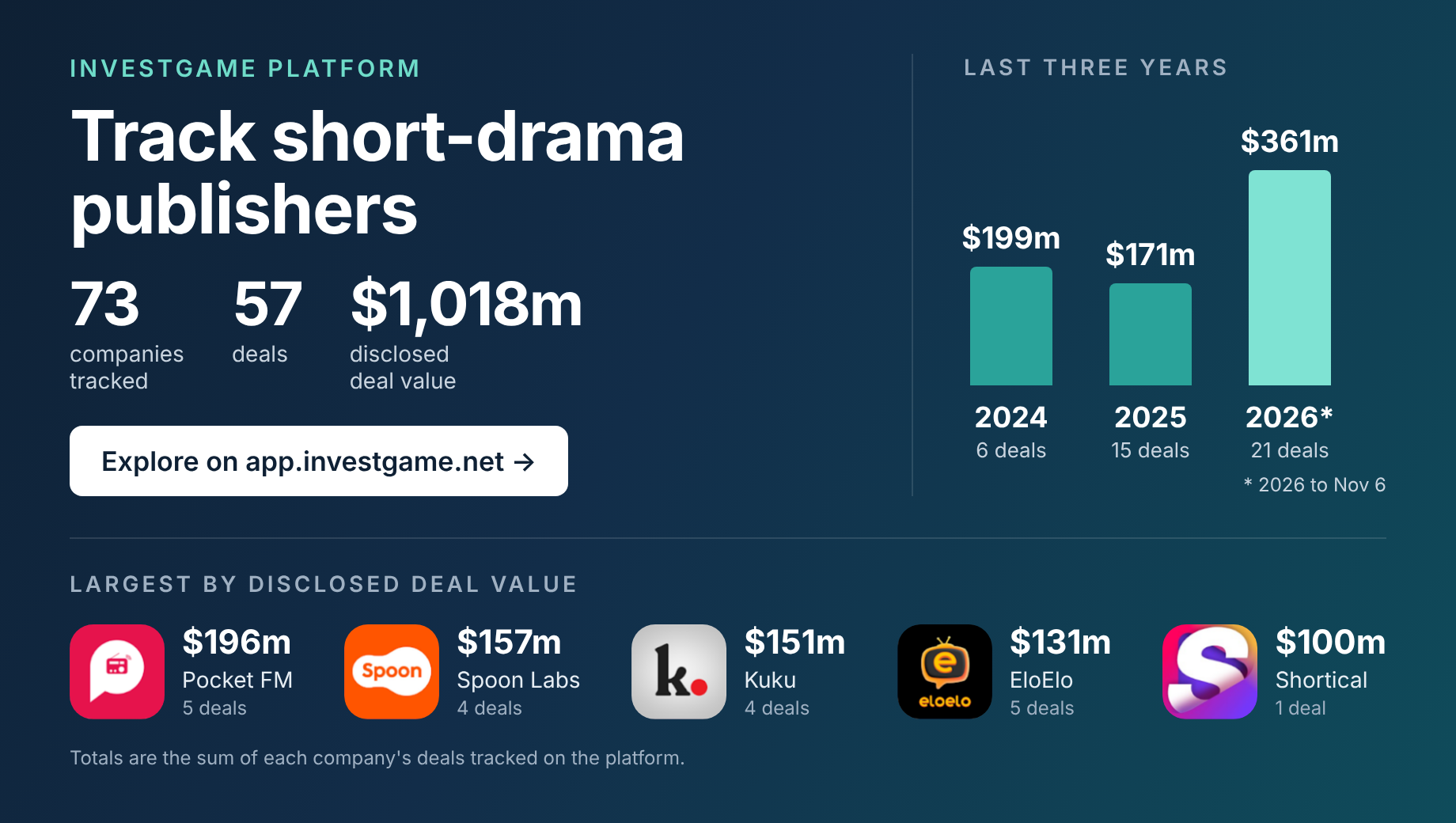
 InvestGame tracks 73 short-drama app companies on its platform. Those companies have done 57 deals since 2018, with $1,018m disclosed across 43 of them: 21 deals and $361m in 2026 to Nov 6, against 15 deals and $171m in 2025.
Silver Lake and PIF reportedly held talks to buy Unity, which has just turned a GAAP profit
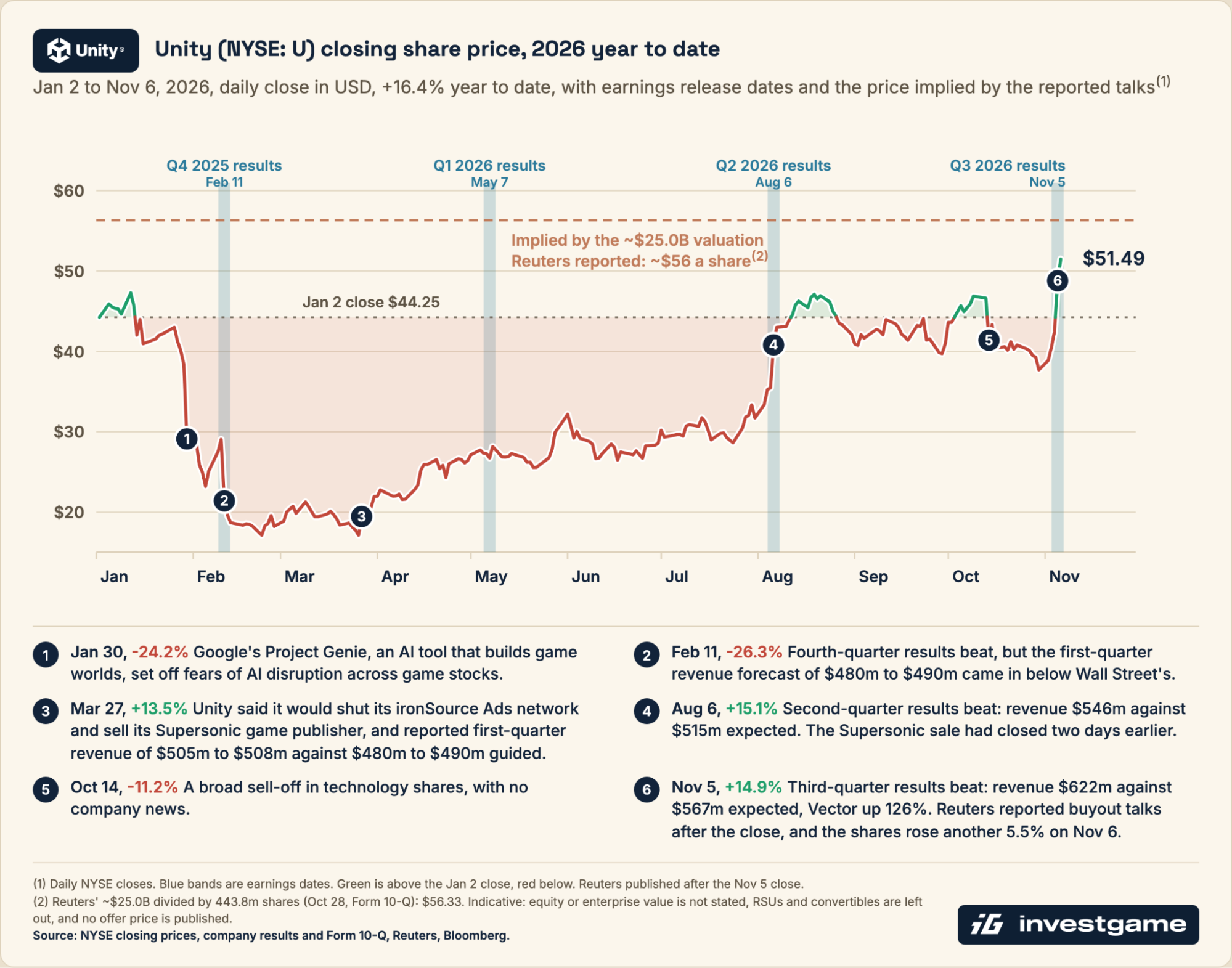
US-based game engine company Unity (NYSE: U) held recent talks to be acquired by a consortium including private equity firm Silver Lake and Saudi Arabia’s sovereign wealth fund PIF, Reuters reported on Nov 5, citing people familiar with the matter. Silver Lake and PIF approached Unity in recent weeks and discussed a valuation of ~$25.0B before its latest earnings report. Unity has been working with an investment bank to evaluate its options, and no deal is certain. Its shares were up about 4% in extended trading after the report, Reuters said.
Unity reported its third-quarter results before the market opened on Nov 5, its first GAAP-profitable quarter since its IPO.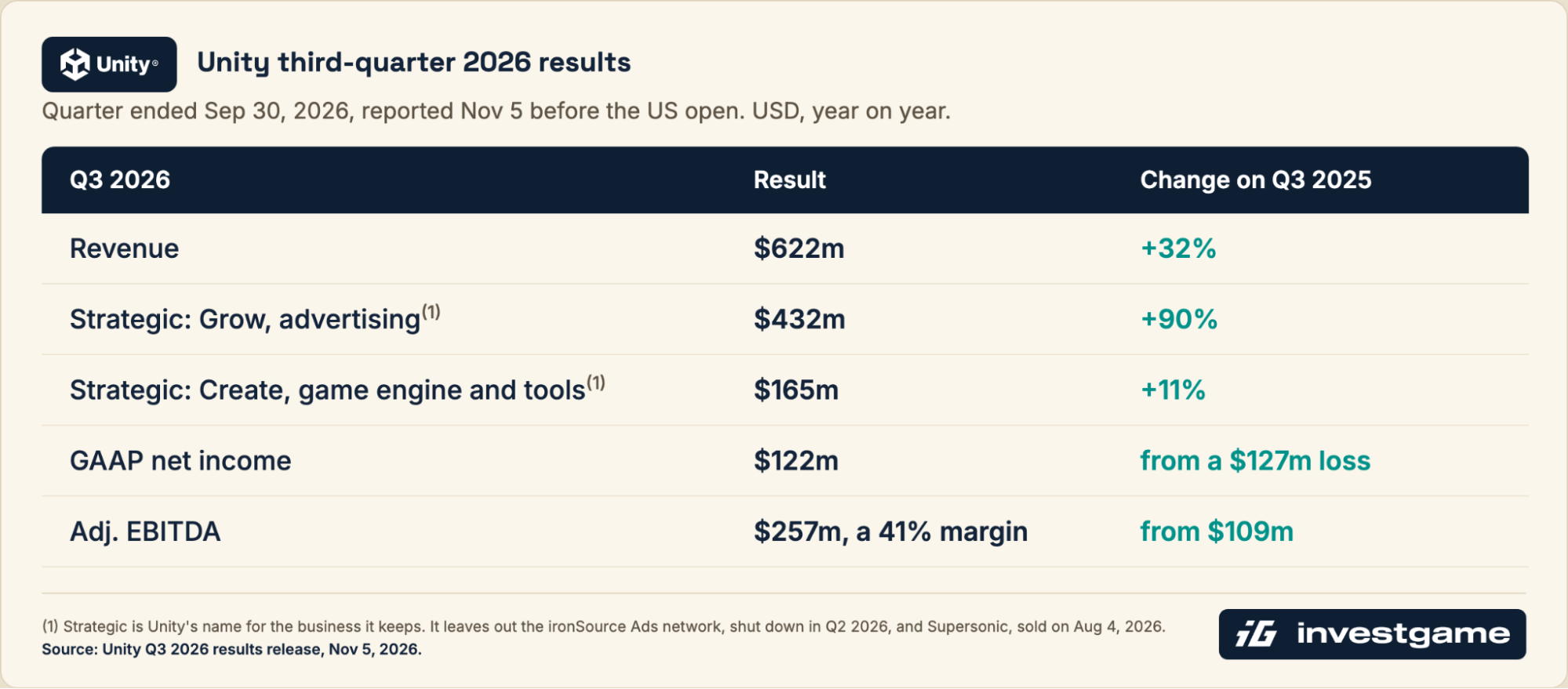 Unity calls the business it is keeping “Strategic”: $597m of revenue, 96% of the total, up 59% YoY. It leaves out the ironSource Ads network, which Unity shut down in the second quarter, and Supersonic, its game publisher, sold on Aug 4. Unity says its Vector ad engine grew 126% YoY. It guided Q4 revenue of $688m to $696m and adj. EBITDA of $290m to $295m, and held $2.6B in cash against $2.2B of convertible notes at Sep 30.
The shares rose 14.9% to $48.80 during the session on Nov 5, hours before Reuters published, and gained another 5.5% to $51.49 on Nov 6, the first session after the report. That close is 36.6% above the Oct 30 close of $37.70.
 Silver Lake announced an investment of up to $400m in Unity in May’17, when Egon Durban, now its Co-CEO, joined Unity’s board, and in Nov’22 it bought most of the $1.0B of 2.0% convertible notes due 2027 that Unity issued with the ironSource merger. A second Silver Lake executive also sits on the board, and Silver Lake funds held about 8% of Unity’s shares in August. Reuters noted that Durban would typically recuse himself from board deliberations on a sale, Reuters noted. In Aug’22, Unity’s board rejected an unsolicited proposal from AppLovin (NASDAQ: APP) to stay with the ironSource merger.
Silver Lake and PIF recently made a deal together: in Sep ’25, they agreed with Affinity Partners to take Electronic Arts private at an enterprise value of ~$55.0B, and the deal closed in Aug’26.
Notable Transactions
MERGERS & ACQUISITIONS
China-based mobile games publisher Gamehaus (NASDAQ: GMHS) is acquiring a 56% stake in Techforge, the Cayman Islands holding company of the AI-native micro-serial app Anamana, for $26.6m. Gamehaus pays $19.6m in 24.5 million newly issued shares at a deemed price of $0.80 each to Techforge’s selling owners and $7.0m in cash for new equity in Techforge. It is a related-party deal. Gamehaus chairman Feng Xie owned around 63.0% of Techforge, and his holding companies received 11.0 million of the 24.5 million shares. The Gamehaus audit committee and board approved the terms. Closing is expected within 30 days of the Nov 2 signing. Gamehaus revenue fell 11.3% to $104.7m in the year to Jun’26, and in a letter to shareholders, Gamehaus calls Anamana the primary engine of its future growth.
Ubisoft (PAR: UBI) is reportedly one of at least three bidders for France-based developer Arkane Studios, maker of the immersive sim Dishonored, Bloomberg reported on Nov 3, citing people familiar with the negotiations. Microsoft (NASDAQ: MSFT), which owns the studio, began works-council consultation on its strategic options on Jul 6, part of the Xbox restructuring InvestGame covered in W44. Two other gaming companies also made offers of unknown value, and Xbox has weighed selling the studio to its management, Bloomberg said. An Xbox spokesperson said the company is exploring options ahead of a December deadline and declined further comment. Arkane’s current project is the third-person action game Marvel’s Blade. Ubisoft guides to a high single-digit negative non-IFRS operating margin in the year to Mar’27.
VENTURE FINANCING
Japan-based fandom infrastructure company OPENREC has raised $8.8m (JPY 1.4B) through new equity and bank loans, split undisclosed. Investment funds of Iyogin Capital, Nomura SPARX Investment and Japan Post Bank Asset Management subscribed to the new equity, and Shoko Chukin Bank and Japan Finance Corporation lent alongside. OPENREC ran the game-streaming service OPENREC.tv until it became the fan-community platform mellow-fan on Jul 1. It earns from subscriptions, events, merchandise, and ads on the platform, which serves talent agencies and artists, and says revenue last year was 1.5 times the year before. The funds go to taking its event series nationwide, creating its own IP, and expanding overseas. Its streamer game tournament holds its finals at Tokyo Dome on Nov 28 and 29.
Cricketer Sachin Tendulkar has made an undisclosed strategic investment in India-based mobile sports-gaming studio Metasports Interactive, the developer of the cricket strategy game Hitwicket. He takes a significant minority stake, becomes the game’s brand ambassador, and appears in it as a playable character. The investment is separate from the $20m user-acquisition financing Metica provided in Apr’26. The company says Hitwicket has passed 20 million downloads across more than 120 countries, that its revenue doubled over the past six months, and that it is targeting 100 million downloads in three years.
EARNINGS REPORTS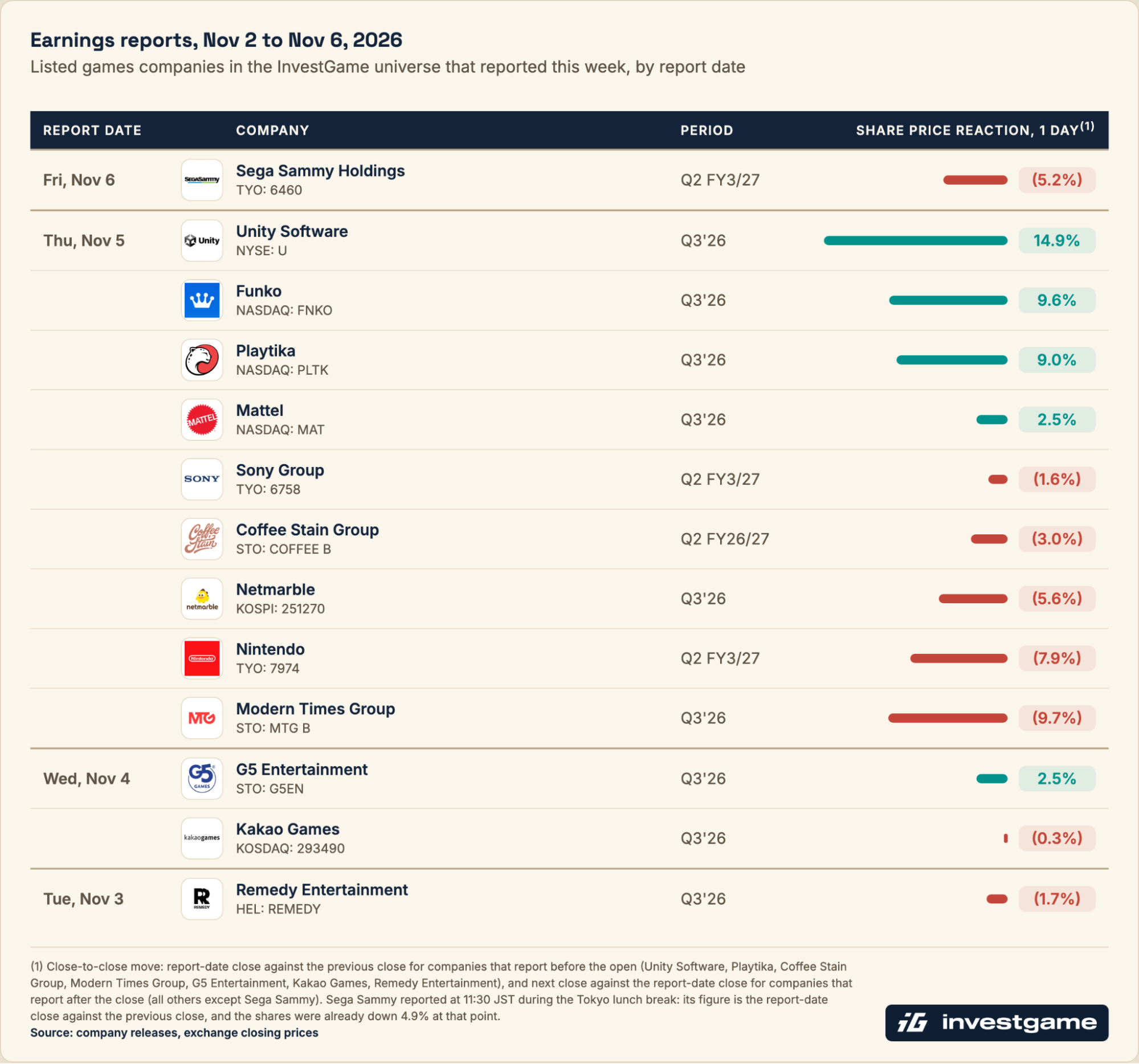
Public Market Performance
Of 64 eligible companies in the tracked universe, 45 rose, 17 fell, and 2 were flat, with a median move of +2.3%, over the Friday Oct 30 to Friday Nov 6 window.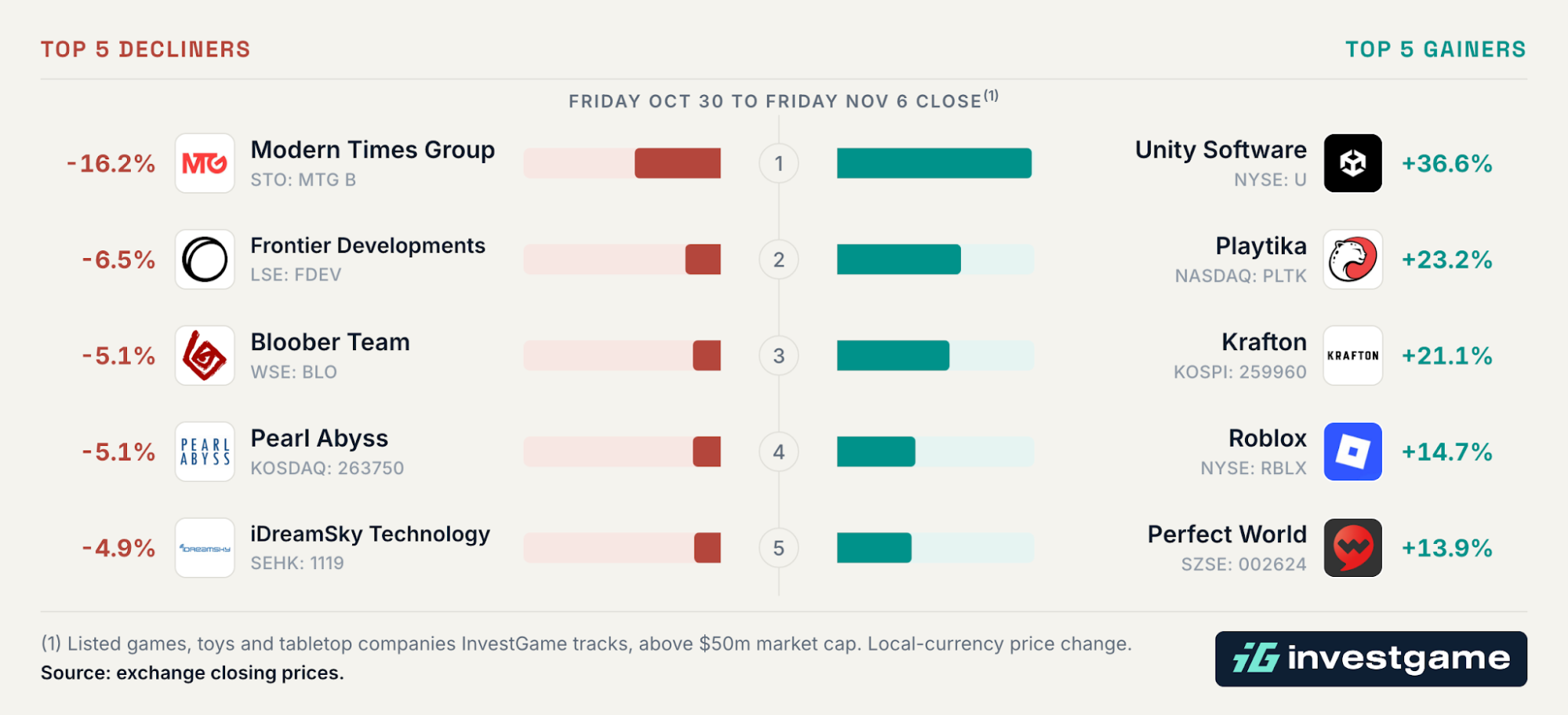
Share Price Signals
Unity (+36.6%) reported Q3 before the US open on Nov 5. Revenue rose 32% YoY to $622m, above the $567m expected and $247m reported, and Unity posted its first GAAP profit since its IPO, $122m, as Vector, its AI ad engine, grew 126% YoY. It guided Q4 adjusted EBITDA to $290m to $295m. After the close, Reuters reported that Silver Lake and PIF had held talks to buy Unity, discussing a valuation of about $25.0B, and the shares rose again on Nov 6. Needham raised its target to $70 from $54 and kept Buy, expecting Vector to reach about 66% of revenue by year-end.
Playtika (+23.2%) reported Q3 before the US open on Nov 5 and said its board ended the strategic review it began in April with no transaction, so it remains independent. Wedbush said adjusted EBITDA reached a record $252m on $224m consensus, a beat it traced to marketing spend down 34% QoQ, while revenue was flat at $674m. Playtika reaffirmed full-year guidance of $2.75B to $2.85B in revenue and $750m to $790m in adjusted EBITDA, and now expects around the midpoint of both. Wedbush kept Neutral on Nov 6 and cut its target to $3.00 from $4.00, because the review ended without a deal and the earn-out obligation grew.
Krafton (+21.1%) announced after the close on Nov 3 that it will buy back $223m (KRW 300.0B) of its own shares between Nov 4 and Feb 3, 2027, and cancel them, and the shares rose the next session. The South Korea-based games company said its share price did not sufficiently reflect its growth potential. It is Krafton’s fourth buyback this year and lifts 2026 shareholder returns to $682m (KRW 917.2B), the largest annual total since it began returning cash in 2023, Maeil Business reported.
Modern Times Group (-16.2%) reported Q3 before the open on Nov 5, in line with the consensus Modular Finance compiled for MTG: net sales of $305m (SEK 2,988m) against $306m (SEK 2,996m), and adjusted EBITDA of $71m (SEK 693m) against $70m (SEK 686m). With these figures, MTG said 2026 pro forma revenue growth is now expected to be toward the lower end of its 5% to 8% range. Playamp revenue fell 6% YoY on a pro forma basis, and PlaySimple’s adjusted EBITDA margin slipped to 21% from 23%. On Nov 6, Danske Bank downgraded MTG to Hold from Buy with a target of SEK 121, and DNB Carnegie cut its target to SEK 155 from 167 and kept Buy.