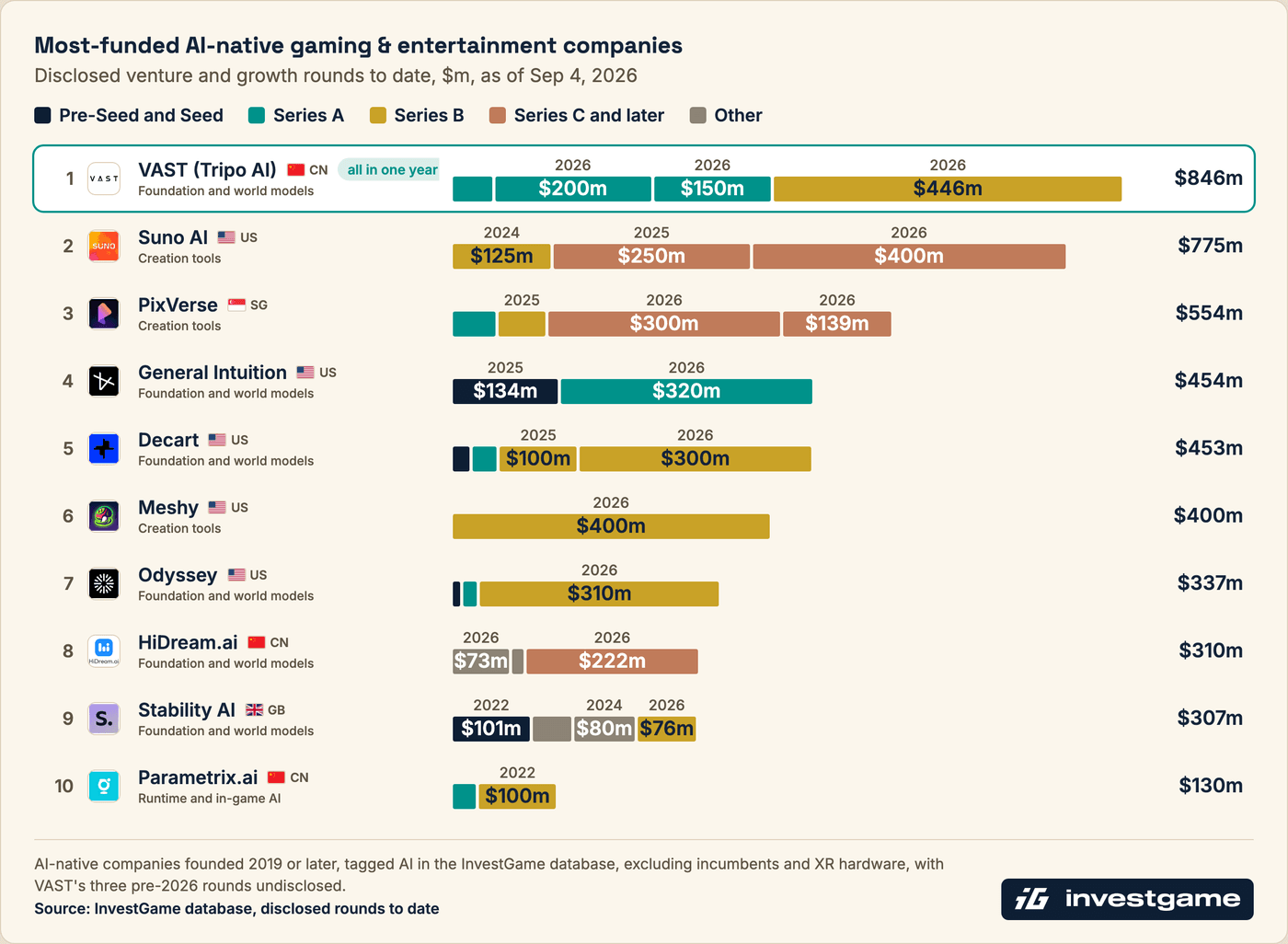
Matrix Partners China has led a ~$446m Series B and B+ into VAST, maker of Tripo AI, in its fourth round of 2026

China-based generative 3D AI company VAST, developer of the 3D asset generator Tripo AI, has raised ~$446m (~RMB 3B) in a Series B and Series B+ round led by Matrix Partners China, announced on Sep 1, 2026. The strategic investors are games publishers Perfect World (SZSE: 002624), 37 Interactive Entertainment (SZSE: 002555), and Yanqu Games; the marketing group BlueFocus (SZSE: 300058); the software company ThunderSoft (SZSE: 300496); and the semiconductor investor SPC. Financial investors CDH VGC, CICC Capital, CMC Capital, Hongtai Aplus, 3H Health Investment, Zhongping Capital, and GreatOrigin Asia joined, and existing backers Fortune Capital, Primavera Capital, 4399 Network, Muhua Tech Ventures, Vitalbridge Capital, INCE Capital, and T-Capital topped up. Proceeds fund 3D-native foundation models, 3D data infrastructure, training and inference compute, and commercialization.
It is VAST’s fourth round of 2026 and more than twice the size of any of the other three. The ladder runs from a $50m Series A co-led by Alibaba (NYSE: BABA) and Hengxu Capital in Mar’26, through a ~$200m Series A+ and A++ co-led by INCE Capital and China Life Yangtze River Delta Sci-Tech Fund in Jun’26, which Bloomberg reported at a valuation of at least $1.0B, to a $150m Series A3 in Jul’26 from Geely Capital, 4399, Tanwan (SEHK: 9890), Giant Network (SZSE: 002558) and Fosun Capital. Its total in less than six months, as 36kr reports, is ~RMB 5B (~$744m), which the company calls a record for AI 3D. The four rounds put VAST first among AI-native companies in gaming and entertainment, at ~$846m of disclosed funding to date, ahead of Suno AI at $775m and PixVerse at $554m. 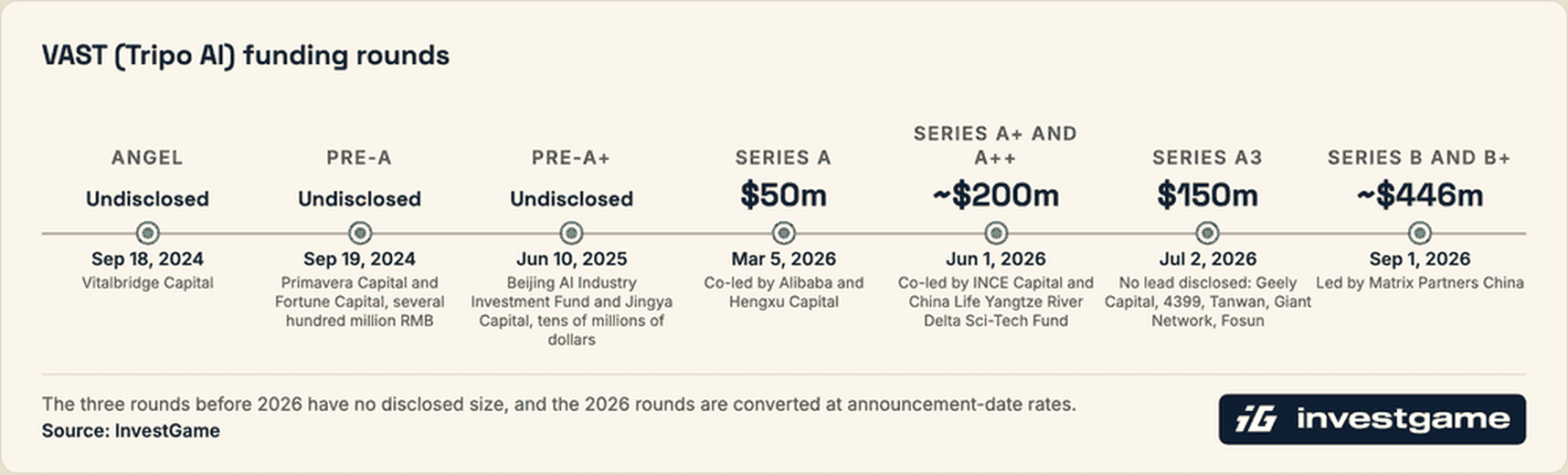
Studios use Tripo to turn a text prompt or a concept image into a finished 3D object or character that can be dropped into a game engine as a prop, character, or environment asset. NetEase (NASDAQ: NTES) runs it in two live games, Eggy Party and Where Winds Meet, and Tencent (SEHK: 700), ByteDance, and Microsoft (NASDAQ: MSFT) use it in internal workflows via the enterprise API. The new P2.0 model, announced with the round, produces assets in the mesh format studios’ animation tools expect, so less manual clean-up is needed before an asset is usable.
VAST has disclosed neither a post-money valuation for this round nor revenue. The WSJ reported in August that VAST sought the round at nearly $2.0B. The priced comparable is Meshy, which raised nearly $400m at a $1.5B valuation in Jul’26, co-led by IDG Capital, Matrix Partners China and Monolith Management, on ~$60m in ARR and 12 million registered users. Matrix Partners China has therefore led the two largest rounds in AI 3D, six weeks apart, on both sides of the rivalry.
Bloomberg reported on Aug 4 that VAST is weighing a Hong Kong IPO with Bank of America (NYSE: BAC) and CICC (SEHK: 3908) at a preliminary stage, and the WSJ said the listing could occur as soon as 2027. CICC Capital, the bank’s private-equity arm, is in this round. Founder and CEO Simon Song co-founded MiniMax (SEHK: 100), which listed in Hong Kong in Jan’26, and Chief Scientist Yanpei Cao led 3D generation at Tencent’s ARC Lab before VAST. InvestGame will continue monitoring the AI 3D category and whether a Hong Kong listing prices VAST at a level above Meshy’s $1.5B.