



US-based tech giant Microsoft (NASDAQ: MSFT) announced on Jul 6, 2026 that it is divesting four first-party Xbox game studios, Undead Labs, Ninja Theory, Compulsion Games, and Double Fine Productions, alongside cutting approximately 3,200 jobs, roughly 20% of its division, split between 1,600 immediate role eliminations and 1,600 more by Jun 30, 2027, part of a broader 4,800-role reduction across Microsoft announced the same day. A fifth studio, Arkane Studios, faces the same outcome pending a legally required French labor review. Xbox is also flattening its platform organization, cutting management layers from as many as 14 down to 5 or fewer. The move lands nearly three years after Microsoft’s $68.7B acquisition of Activision Blizzard closed in Oct’23, and marks the fifth major layoff round at the gaming unit since that deal. Across those rounds, Microsoft has confirmed at least 5,750 gaming-division layoffs since the acquisition, with the true total likely higher.
The five PC & Console game developers break down as follows:
- US-based Undead Labs, founded in 2009 with around 110 employees and known for the post-apocalyptic survival game series State of Decay, is being sold to an undisclosed buyer, with funding secured to complete State of Decay 3.
- UK-based Ninja Theory, founded in 2000 with around 136 employees and known for the psychological action-adventure game Hellblade: Senua’s Sacrifice, is moving to undisclosed new ownership and has funding to finish its next Senua game.
- Canada-based Compulsion Games, founded in 2009 with around 90 employees and known for the survival action-adventure game We Happy Few and the platform-adventure title South of Midnight, is spinning out through a management buyout, retaining its IP and catalog.
- US-based Double Fine was founded by Tim Schafer in 2000 and today employs around 100 people. Its debut title, the platform-adventure game Psychonauts, remains the studio’s signature franchise, later followed by Psychonauts 2. The studio is now spinning out via a management buyout, regaining independence with its IP and catalog intact.
- France-based Arkane Studios founded in Lyon in 1999, the studio later expanded into a two-office structure, with teams in Lyon and Austin known for the immersive sims Dishonored, Prey, and Deathloop. Microsoft closed Arkane Austin in May’24 following Redfall, ending further development of the game and cutting 96 jobs. Today employs around 110 people at its remaining Lyon studio. It is the fifth and most complicated case: French labor law requires a Works Council review before any sale, closure, or restructuring, complicated by its unreleased action game, Marvel’s Blade, reportedly running over budget.
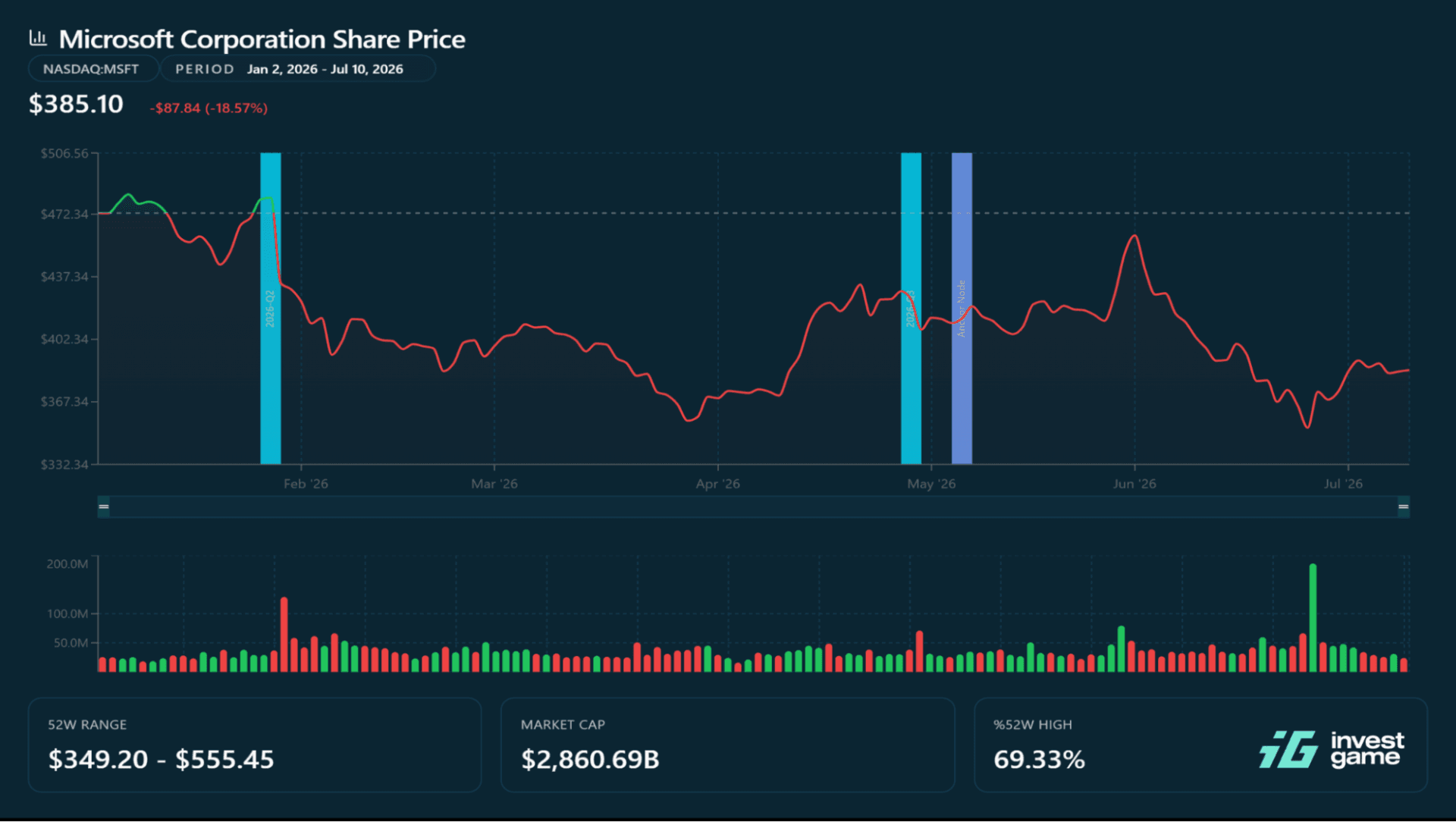
Microsoft shares fell 0.96% to close at $386.74 on the day of the announcement, a muted single-day move set against a much steeper ~19% YTD decline in the stock, driven largely by investor concern over surging AI capital expenditure rather than by the gaming unit specifically. Shares closed within a tight $383-$389 band over the following week, finishing at $385.10 by Jul 10, 2026.
Asha Sharma, who became Xbox CEO on Feb 20, 2026, following Phil Spencer‘s retirement after a 38-year tenure at Microsoft, attributed the reset to weak unit economics, with Xbox operating at margins 3 to 10 times lower than comparable platform and publishing businesses and losing “64 cents for every dollar we invested” in a typical year. Underlying that strain is a Game Pass shortfall: a document disclosed during the Activision trial shows Microsoft had projected 77 million subscribers by 2026, but actual subscribers sit around 30 million, down 4 million from 2024 after a price increase drove cancellations. Rising console costs compound the pressure: Microsoft has raised the price of its current Xbox console three times in 13 months, with its next-generation console expected to carry a price tag above $1,000.
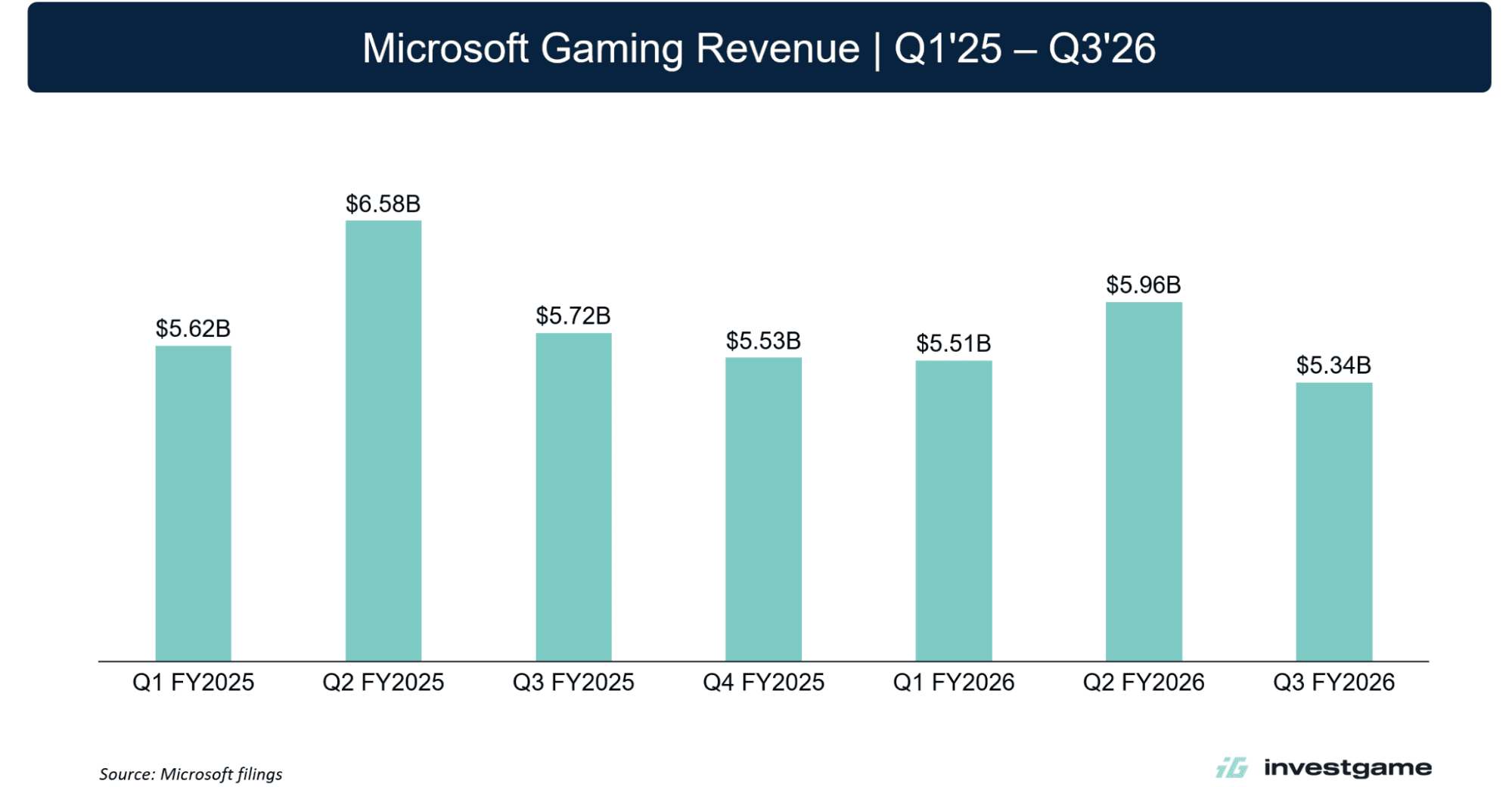
The numbers back up Sharma’s diagnosis: Gaming was the weak spot in an otherwise strong quarter for Microsoft, whose total revenue grew 18% YoY to $82.9B in fiscal Q3 2026. Gaming revenue fell $380m, or ~7% YoY, to $5.34B in fiscal Q3 2026, as Xbox content and services dropped 5% against a tough prior-year comparison, while hardware sales fell even harder, down 33% on weaker console volumes. Every comparable quarter in fiscal 2026 has landed below its year-ago period, a sign this isn’t a one-quarter dip but a sustained slide.
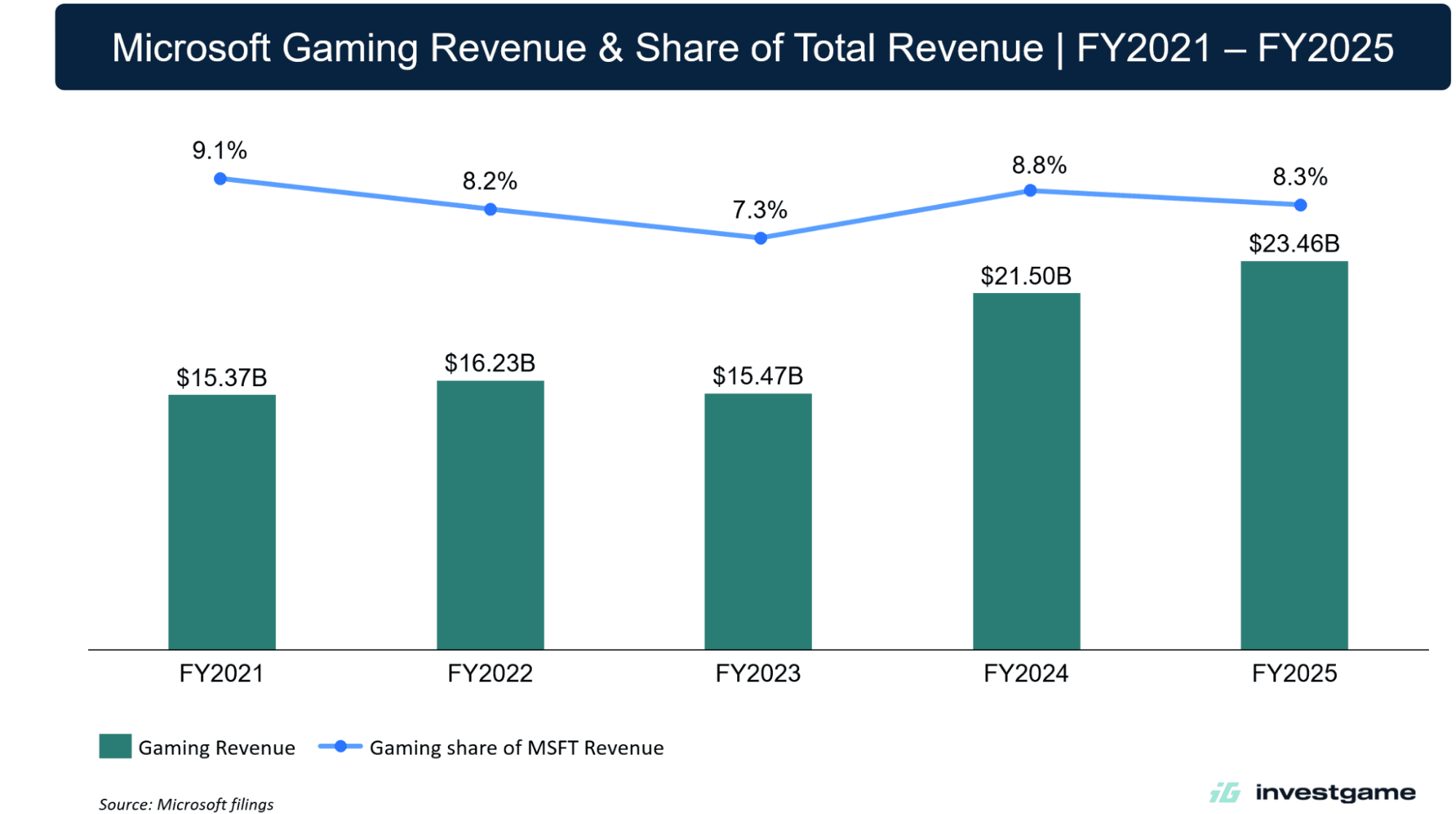
Zooming out to the annual picture over the past five years, Microsoft’s gaming revenue stayed roughly flat between FY2021 and FY2023, then jumped 39% YoY in FY2024 after the Activision Blizzard acquisition closed, and grew again in FY2025, up 9% YoY, to a new high. Content and services, driven by Activision Blizzard and Game Pass, powered that growth in both years, while hardware revenue continued to fall as console sales weakened. Game Pass alone generated nearly $5B in FY2025, and Microsoft became the top publisher on both Xbox and PlayStation, helped by releases including Forza Horizon 5, The Elder Scrolls IV: Oblivion Remastered, and the Call of Duty: Black Ops 6 launch. Overall, gaming revenue grew at a CAGR of roughly 11% between FY2021 and FY2025.
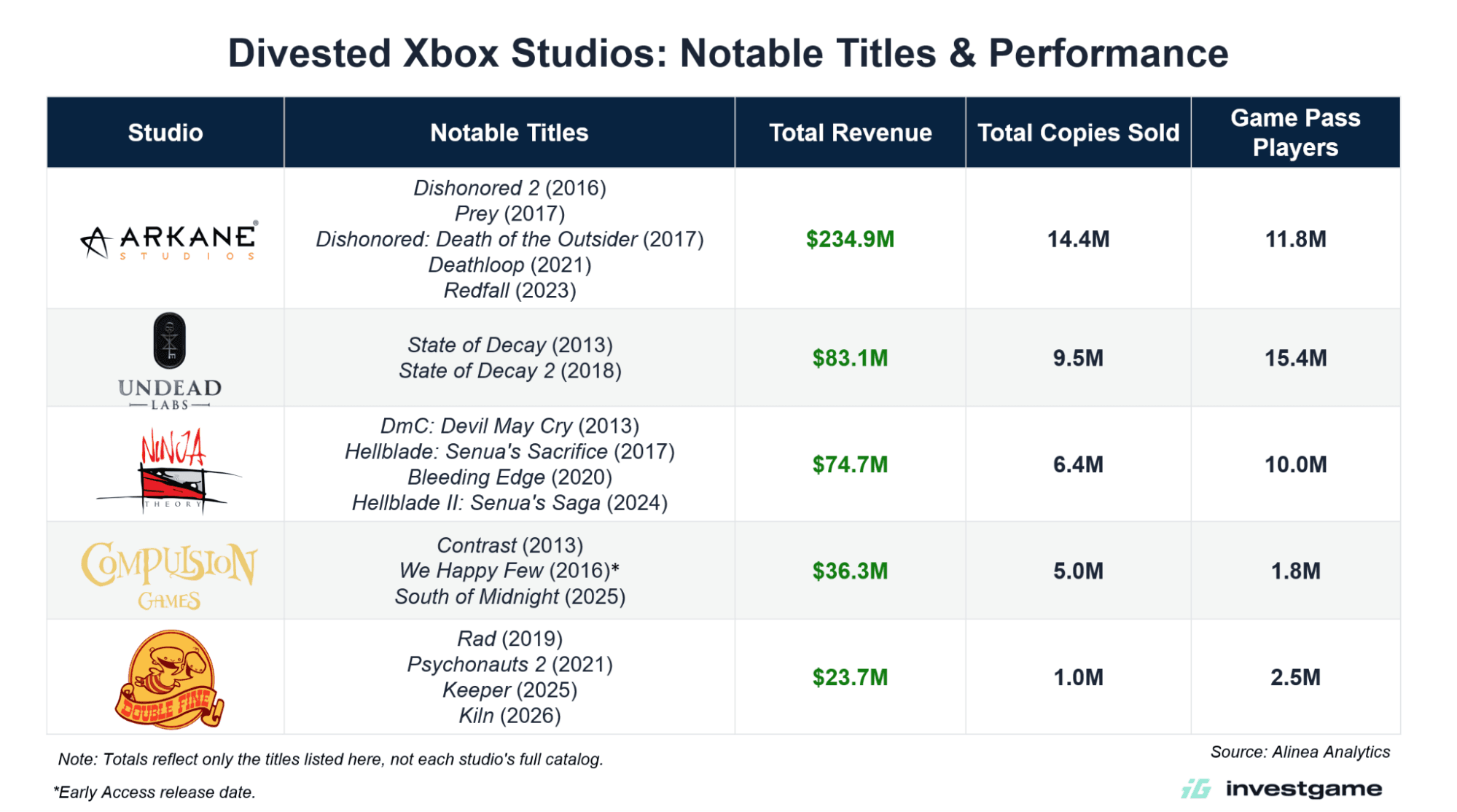
Ninja Theory, Undead Labs, Compulsion Games, and Double Fine all joined Xbox during its 2018 to 2019 acquisition wave. The first three studios were announced together at Microsoft’s Xbox E3 2018 briefing on Jun 10, 2018, on undisclosed terms. Ninja Theory’s price was only revealed in 2023, when internal Microsoft documents surfaced in FTC v. Microsoft litigation valuing the Cambridge studio at approximately $117m. Double Fine followed a year later, joining Xbox Game Studios at E3 2019 on Jun 9, 2019, for an undisclosed sum. Arkane arrived differently: it was folded into Microsoft’s $7.5B acquisition of ZeniMax Media, Bethesda Softworks‘ parent, announced Sep 21, 2020, and completed in Mar’21 alongside Bethesda Game Studios, id Software, and MachineGames, several of which are also seeing job cuts now.
Microsoft is not the only large gaming company making divestitures and cutting jobs after the post-COVID expansion of teams, production budgets, and studio portfolios. Embracer Group (STO: EMBRAC B) was one of the first major examples, launching a restructuring program in Jun’23, cutting 904 jobs by Nov’23, and closing studios including Volition and Free Radical Design. It later completed the $247m management-led buyout of selected Saber Interactive assets by Beacon Interactive, controlled by Saber co-founder Matthew Karch, sold Gearbox Entertainment to Take-Two Interactive (NASDAQ: TTWO) for $460m, and divested Easybrain to Miniclip for $1.2B. Sony (TYO: 6758) followed a similar path across several acquired studios, cutting 220 roles at Bungie, 17% of the studio, in Jul’24. That October, PC & PlayStation hero shooter Concord flopped, and Sony shut down its developer, Firewalk Studios, cutting 172 jobs; the same day, it closed its mobile studio, Neon Koi, cutting 38 more jobs. Then in Feb’26, Sony shut down the highly regarded Bluepoint Games, known for the Demon’s Souls and Shadow of the Colossus remakes. NetEase is undergoing a different kind of reset, pulling back from its international expansion and reviewing the future of several overseas studios, while Stillfront Group (STO: SF) is rationalizing its acquisition-built mobile portfolio around a smaller set of key franchises. EA (NASDAQ: EA) and Ubisoft (PAR: UBI) are also reducing costs and narrowing their portfolios, with EA making further cuts across its teams and Ubisoft reducing headcount, closing studios, and putting additional roles at risk. The situations are not identical, but the broader pattern is clear: after years of aggressive organic growth and M&A, higher development costs, larger teams, and slower growth are pushing major gaming companies toward stricter capital allocation, fewer projects, and leaner studio portfolios.
We will continue to monitor Arkane’s Works Council outcome, the divested studios’ footing under new ownership, Game Pass subscriber trajectory, and Xbox’s promised return to growth in 2027.




